How to store an inflatable paddleboard for winter
Prepare your inflatable paddleboard for winter with a storage-location checklist, manufacturer-specific packing guidance, and checks before the next season.
Updated
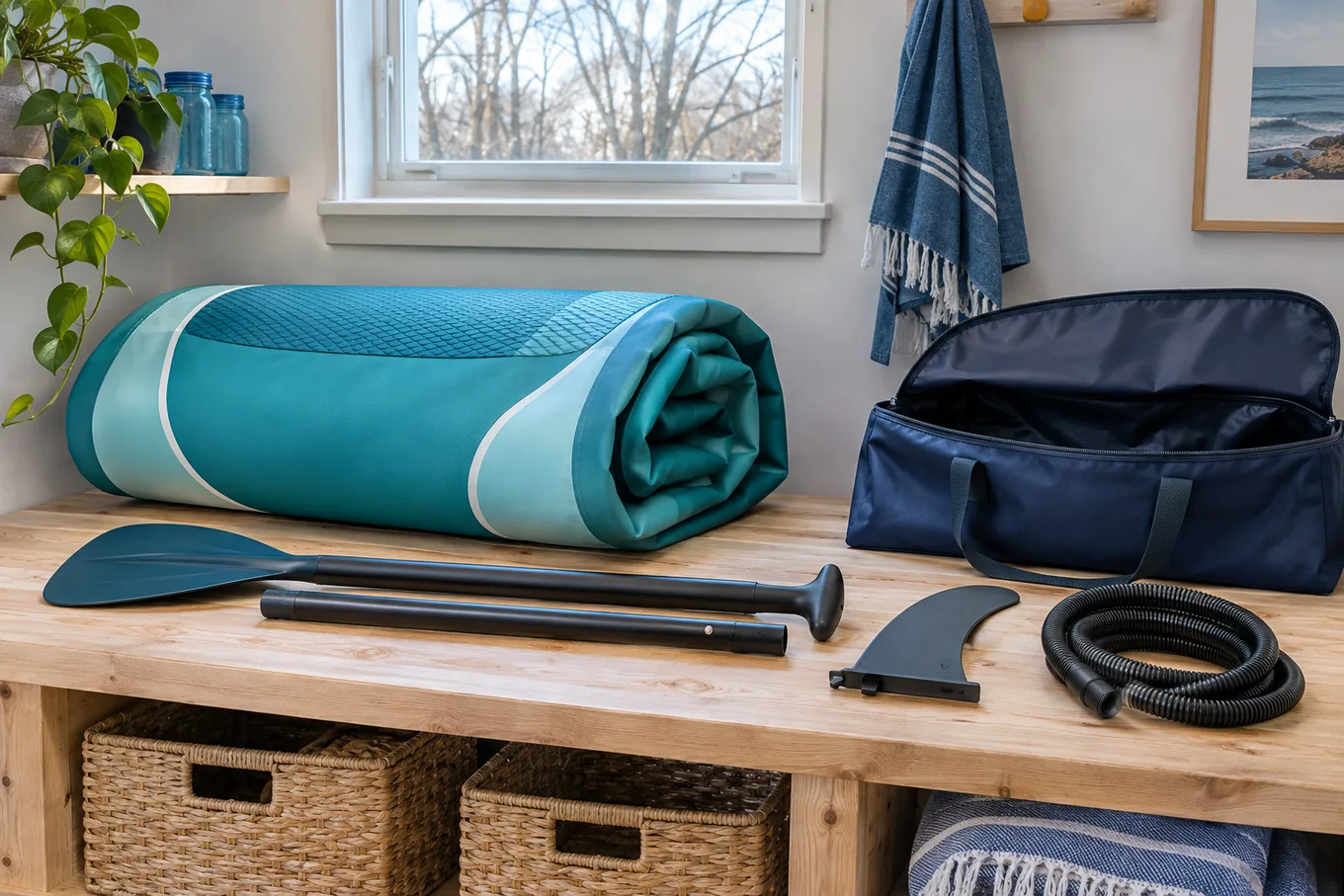
Choose a winter storage spot before packing your inflatable stand-up paddleboard, or SUP, away. Find the storage instructions for your exact board and compare them with the conditions in your proposed closet, garage, or shed. Then clean and dry the kit, record any problems, and choose the storage arrangement its manufacturer allows.
Check the space before packing the board
Look at the actual spot where the board will sit. Is it sheltered from rain and snow? Does dampness collect there? Is it beside a heater, against a window, or on a floor that becomes wet? Check whether you can reach the stored board without moving a winter’s worth of boxes.
Paddle North distinguishes cold storage in an unheated garage, cabin, or shed from storage in a temperature-controlled space. Its winter guide allows different packing arrangements for those environments. That is a useful reason to describe your storage conditions when asking a manufacturer for advice. The word “garage” alone leaves important details unresolved. Paddle North’s winter storage guidance
| Proposed location | What to check | Next action |
|---|---|---|
| Closet or indoor room | Room for the permitted roll or inflated arrangement, heat sources, and access | Measure the available space against your board’s storage instructions |
| Unheated garage or shed | Expected temperature changes, dampness, precipitation, and the floor | Ask the board maker whether those conditions and your packing plan are suitable |
| Basement or utility room | Moisture, heating equipment, and the chance of stored items pressing on the board | Choose a protected position you can inspect |
| Exposed outdoor spot | Rain, snow, sunlight, and changing conditions | Find out what protection the manufacturer requires before committing to the location |
If the manual gives no storage temperature range and your proposed space gets very cold, contact the maker with the model, model year, and expected conditions. A generic temperature number from another board’s care article cannot resolve that question.
Finish cleanup and inspect the kit
Set aside time to deal with the board and accessories before the final pack. Red’s winter guide recommends freshwater cleaning, complete drying, and loose packing that avoids pressure points. It favors a cool, dry indoor location, sheltered from sunlight and changes in temperature and humidity, ideally raised off the ground. Keep the cleaning products and packing method consistent with your own board’s instructions. Red’s winter SUP care guide
If cleanup is awkward in your home, use the apartment rinsing and drying routine to plan the working space. For seasonal storage, add an inspection before the equipment disappears into its bag.
Look over the board, handles, bungees, fin fittings, paddle, and transport bag. Write down anything that needs attention and take a clear photograph of the affected area. This creates a record you can send to support and revisit before the next outing. Resolve a suspected equipment problem through the relevant manufacturer’s guidance.
Follow your board’s rolling and valve instructions
The storage section is worth reading even if you already know how to deflate the board after a normal outing. Manufacturers can give different advice about air left inside and the valve’s position during storage.
For example, the NRS version 6 inflatable SUP owner’s manual permits unfolded storage with a small amount of air in a cool, dry place. For limited space, it describes a loose roll with the valve open, raised off dirt or concrete. Its care section also warns about water entering through an open valve in wet conditions. NRS inflatable SUP owner’s manual
The 2025 Retrospec Weekender manual gives a different sequence. It calls for deflation after use, cleaning and drying, removal of the removable fins, and rolling. After that, it directs the user to close the valve stem in the UP position and replace the cap. It also warns against fully inflated storage. Those instructions belong to that Weekender manual. Retrospec Weekender 2025 manual
Use the instructions matching your equipment. If you cannot identify the manual, ask the maker to confirm the storage arrangement, valve position, and whether any storage pressure applies. Keep the answer with your equipment records so you can repeat the arrangement next year.
Leave the kit ready to inspect
Use this checklist as you put everything away.
- Board and accessories are clean and dry.
- Removable parts have been handled as the matching instructions require.
- The roll, support, valve position, and cap follow those instructions.
- Hard accessories and other stored objects will not press into the board.
- The pump, paddle, fins, leash, and small fittings have identifiable places.
- Any unresolved problem is recorded where you will see it before the next trip.
Follow separate care instructions for the pump and other equipment, including any battery. Keep the stored kit accessible. A visual check after a leak in the room, new dampness, or a change in storage location can tell you whether you need to unpack and reassess it.
Inspect before the first outing of the season
Bring the board onto a clean, suitable surface and inspect it before making launch plans. iROCKER’s season-preparation guide includes checking the board, seams and valves, handles and bungees, fin boxes, pump, paddle, and personal flotation device. Use the matching equipment instructions to investigate wear, damage, or suspected leaks. iROCKER’s season-preparation checklist
Allow time for supervised inflation to your board’s specified pressure while you are still at home. If the reading is questionable, work through the pump gauge guide and resolve the uncertainty before going out. Address suspected damage or leaks before returning to the water.
Then revisit your first-paddle plan for the launch and conditions. Start your storage record with the exact board model, the location you have chosen, and any question you still need the manufacturer to answer.