What size dry bag do you need for paddleboarding?
Compare closed dry-bag dimensions, allow room for the roll-top, and check that your day-trip gear fits.
Updated
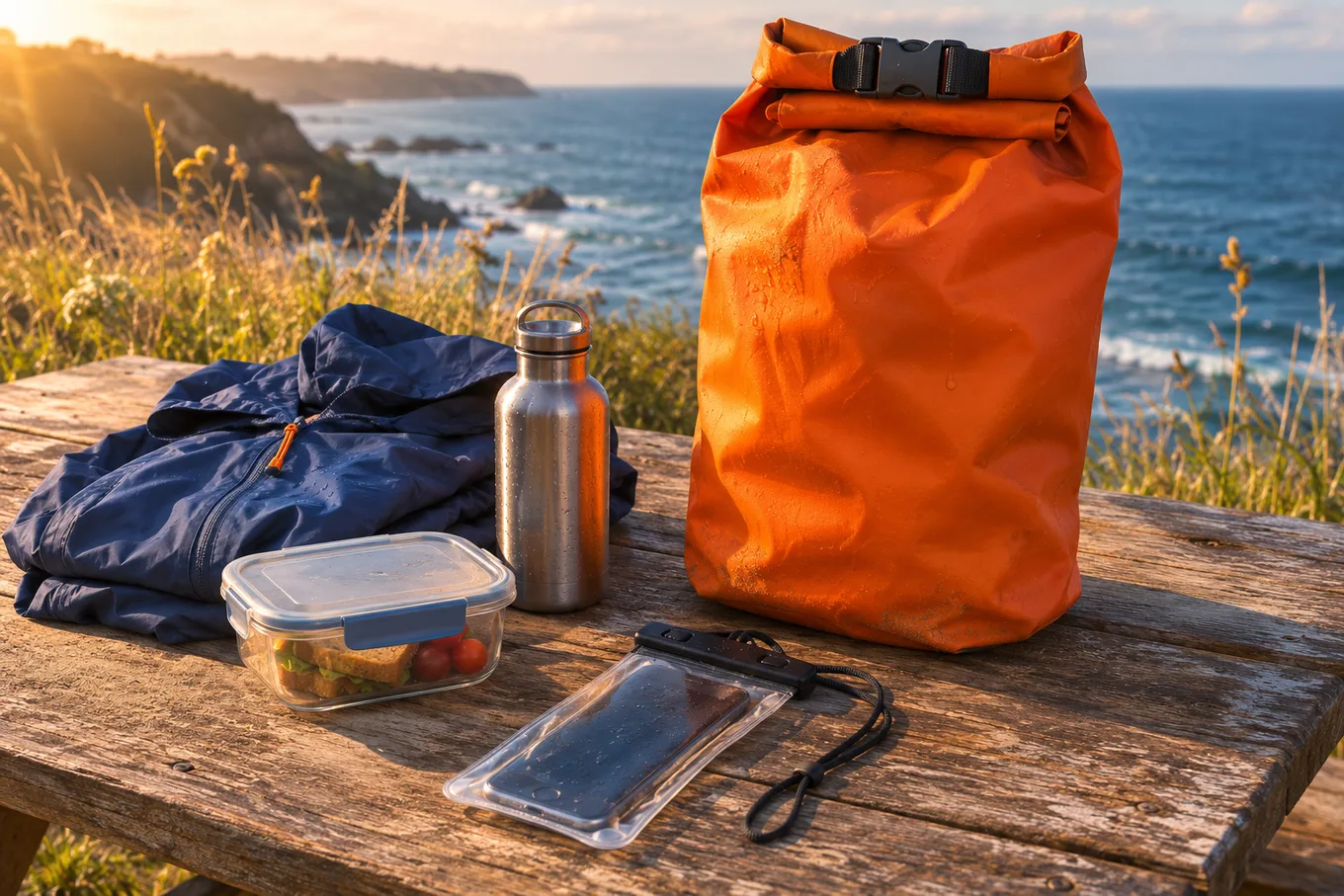
Choose a dry bag around the things you will actually carry and the space they occupy when the bag is properly closed. A capacity label can help you shortlist sizes, but it cannot tell you whether your towel, lunch container, or extra layer will fit together.
Lay your intended kit on a table before shopping. Separate the items that need protection from the things that will go elsewhere. If you are still deciding what belongs on the outing, start with the first-paddle guide.
Make a packing list for this trip
Write down the specific items. “Extra clothing” could mean a thin top or a bulky change of clothes. “Lunch” could be a small pouch or a rigid box. The shapes affect how you can arrange the contents.
A useful starting list might include your phone protection, keys, wallet, snacks, and a layer. Then add anything the particular outing requires.
For a shared bag, place both people’s equipment together. This makes it harder to overlook the second towel or additional food while estimating the space you need.
Compare dimensions with the bag closed
The following examples come from Sea to Summit’s U.S. Lightweight Dry Bag specification table. The manufacturer gives these heights with the top rolled three times. Use the dimensions to shortlist a bag for your own packing check.
| Listed capacity | Closed height | Base dimensions |
|---|---|---|
| 5 liters | 12.6 inches | 5.5 × 6.6 inches |
| 8 liters | 15.35 inches | 6.5 × 7.8 inches |
| 13 liters | 18.07 inches | 7.9 × 8.7 inches |
| 20 liters | 18.82 inches | 9.2 × 10.7 inches |
The dimensions come from the manufacturer. Sea to Summit also advises avoiding submersion of this roll-top bag because water can enter through the closure. Lightweight Dry Bag specifications
The 13- and 20-liter examples illustrate why height alone is an incomplete comparison. Their base dimensions differ too. Measure the longest or most awkward item on your list, then compare it with the candidate bag’s shape and opening.
If a retailer supplies only an open height, ask for the closed dimensions. That gives you a more useful measurement to compare against the space on your board.
Leave room to make the closure
A roll-top needs spare material at its opening to close as instructed. Packing right up to the top can leave you with a bag that contains the items but cannot form the required closure.
Sea to Summit’s closure guidance calls for inspecting the fabric and coating, releasing excess air, folding over the sealing strip, then making at least two more rolls before clipping the buckle. Follow the instructions for the particular bag you choose. Sea to Summit roll-top instructions
When trying a bag, make the complete closure every time. If you must remove something to finish it, that item needs another planned home or the bag needs to be larger. This is a more useful fit check than judging the bag while it stands open.
Match protection to the contents
Check the protection limits for both the bag and anything you put inside it. A phone, electronic key, and snack packet do not have the same consequence if they become wet. Choose protection for the exposure you need to cover and follow the relevant product instructions.
An intact bag and correct closure are part of that decision. Neither the capacity number nor the word “dry” establishes how a bag will perform when immersed. Avoid testing that assumption with valuable electronics inside.
If your plan includes carrying an electric pump, inspect its dimensions and water-exposure instructions separately. The bag and pump storage guide helps you decide whether that equipment needs to come on the board at all.
Do a complete fit check at home
Put your actual kit in the candidate bag and close it according to the instructions. Then check its loaded shape against your board’s intended storage area and attachment guidance. Allow for the other equipment you need to carry and include the load in the board’s capacity calculation.
Before the outing, you should be able to answer three questions. Does everything on your list fit? Can the closure be made correctly? Does the loaded bag have an appropriate place on the board? Those checks give you a practical basis for choosing the size.